We're the team at The Reputation.org, and the most common thing we hear from a business owner is some version of "I reported the review and nothing happened." So before you flag anything again, it helps to know why Google says no. In almost every case it comes down to one of seven reasons, and once you know which one you're facing, Google review removal from The Reputation starts with an honest read of exactly that.
If you want this in under a minute, watch a short video where Joshua Albanese, founder of The Reputation.org, explains how to remove bad Google reviews.
Why won't Google remove a negative review?
Because a negative review is not a rule violation. Google only removes reviews that break its content policy, so being harsh, unfair, or bad for business is not enough on its own. There is no button that deletes a review you dislike, and there was never meant to be one.
That single fact explains most of the frustration owners feel. You know the review is hurting you, so it feels like it should come down, but Google is judging the review against its own rules, not against your feelings about it. When the review doesn't break a rule, the request fails, and the failure is silent.
Below are the seven reasons a removal request gets rejected, in the order we see them most. Each one comes with what to do instead, because "no" from Google almost never means "nothing you can do."
The 7 reasons Google won't remove a review
Every rejected request we review falls into one of these seven buckets. Find yours, then jump to the fix.
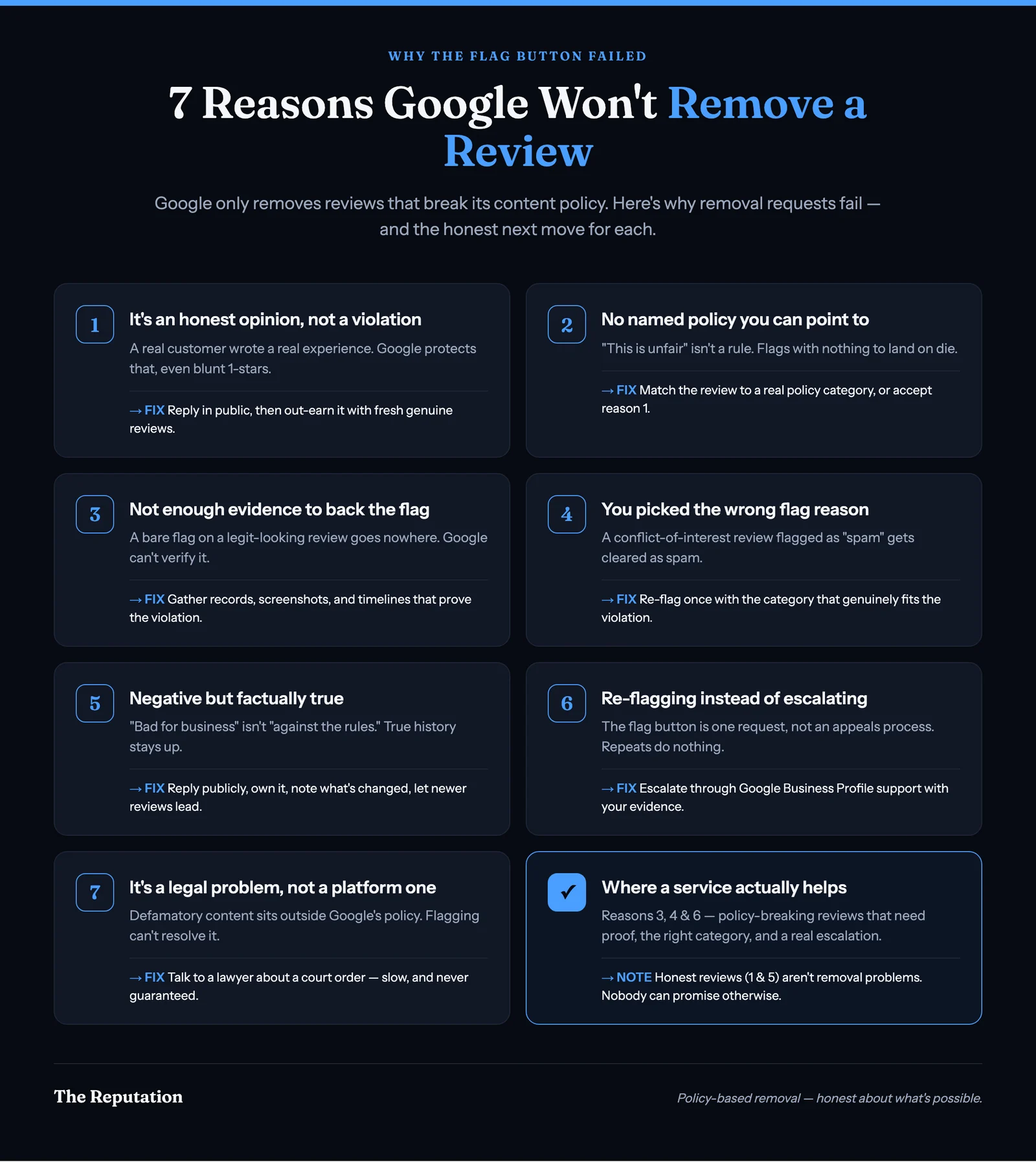
1. It's an honest opinion, not a policy violation
This is the reason behind most rejections. A real customer had a real experience and wrote about it, and Google protects that even when the wording feels exaggerated or one-sided. Blunt 1-stars with no explanation count too.
The exact policy that keeps a critic's honest review up is the same one that stops a rival from mass-flagging your positive reviews. It cuts both ways, and that's the point.
What to do: Respond in public, calmly and specifically, then out-earn it with a steady flow of fresh genuine reviews. Volume and recency push an old negative one down the page. This is the backbone of any reputation management plan worth paying for.
2. The review doesn't actually break a policy you can name
Google's process is built to act on named violations, not on "this is unfair." If you can't point to a specific rule the review breaks, the request has nothing to land on.
Owners often feel a review is wrong without being able to say which policy it crosses. That gap is exactly where flags die.
What to do: Read Google's prohibited and restricted content policies and match your review to one category, such as fake engagement, spam, off-topic, or conflict of interest. If none fit, it's an honest review, and reason 1 applies.
3. There's not enough evidence to back the flag
Anyone can click "flag," which is why a bare flag on a review that looks legitimate usually goes nowhere. Google can't verify a claim you don't support.
A review that breaks policy but arrives with no proof looks identical to an honest one from the outside. The burden is on you to show the difference.
What to do: Gather records that prove the reviewer was never a customer, screenshots of a coordinated pattern, or a timeline that exposes a competitor. Our monitoring work catches and documents these while the trail is still fresh.
4. You picked the wrong flag reason
When you flag a review, you choose a category, and choosing the wrong one sends your case down a path that doesn't fit the facts. A conflict-of-interest review flagged as "spam" gets assessed as spam and cleared.
This is one of the most fixable reasons on the list, and one of the most overlooked. The accurate reason matters far more than most people expect.
What to do: Re-flag once with the category that genuinely fits the violation. If a fake review from a non-customer is the issue, "fake engagement" is usually the right call, not "off-topic."
5. The review is negative but factually true
An embarrassing complaint that actually happened is not removable, even when it makes you wince. "Bad for business" and "against the rules" are not the same thing, and Google only acts on the second.
An old review about a problem you've since fixed sits here too. It's true history, so it stays.
What to do: Reply publicly and own the issue, note what's changed, and let newer reviews carry the current story. A specific, non-defensive reply can quietly turn a bad review into a trust signal for the next reader.
6. You're re-flagging instead of escalating
Clicking "flag" a second, third, and fourth time on the same review doesn't strengthen your case. Google already assessed it. Repeating the same weak signal changes nothing, and a pattern of false flags can put your own profile at risk.
The flag button is a first request, not an appeals process. Once it fails, you've used it.
What to do: Escalate through Google Business Profile support, where a support agent can review a genuine case with your documented evidence attached. That's a different, stronger channel than the flag you already tried.
7. It's a legal problem, not a platform one
Some reviews are defamatory or otherwise unlawful, and those sit outside Google's content policy entirely. Flagging can't resolve a legal question, so the platform route stalls.
Honest opinion is protected speech, so this path is narrow. It applies only when content is genuinely false and provably damaging, not merely unwelcome.
What to do: Talk to a lawyer about whether a court order against the reviewer or content is realistic. It's slow and never guaranteed, so weigh it against the response-and-out-earn route for anything short of clear defamation.
Which of these can a removal service actually help with?
The ones that turn on evidence and correct framing, not the ones about honest opinion. A specialist earns its keep on reasons 3, 4, and 6, where a case genuinely breaks policy but needs proof, the right category, and a real escalation to succeed.
Google's own process rewards a request that says "this violates a specific named policy, and here is why" over one that says "this feels unfair." Building that case and running the escalation well is the part most owners don't have time for.
Reasons 1 and 5, the honest reviews, are not removal problems at all, and any service that claims otherwise is selling false hope. Reason 7 belongs to a lawyer. The Google review removal service exists for the policy-breaking reviews, and our broader review removal work applies the same logic across Yelp, Trustpilot, and Glassdoor, each with its own version of these rules.
What to do when the review is here to stay
Respond well and out-earn it. When a review falls into the honest-opinion bucket, the goal shifts from deletion to damage control and long-term reputation building, and that route is completely within your control.
A strong public reply does two jobs at once. It shows the unhappy reviewer you take the feedback seriously, and more importantly it speaks to every future customer who reads that review later. What they're judging is how you handle criticism.
From there, the durable fix is volume and recency. A steady stream of recent, genuine positive reviews pushes an old negative one down and pulls your average back up, without breaking a single policy. If you want to understand which reviews qualify for removal versus which don't, our breakdown of what Google will actually remove walks through the exact line.
The questions we hear most about why Google won't remove a review, answered plainly.
Want to know if your review can actually come down?
If a Google review is hurting your business, the first step is knowing which of these seven reasons you're facing, and whether the review breaks policy or is one you'll need to respond to instead. Start a case review with The Reputation and we'll tell you honestly what can come down, what can't, and what to do about the reviews that are here to stay. Performance-based pricing applies to qualified removals: scope, eligibility, and timing are confirmed during your case review, and some content is legally or technically constrained, so we tell you what's achievable before you commit. This article is general information, not legal advice.
This article was written by The Reputation Team, the online reputation specialists at The Reputation.org. We handle policy-based review removal, reputation management, and monitoring for businesses and individuals, and we only pursue removals that fit a platform's published rules or the law.
Frequently asked questions
Why won't Google remove a negative review?
Because a negative review is not against the rules. Google only removes reviews that break its content policy, such as fake reviews, spam, off-topic posts, or conflicts of interest. An honest 1-star from a real customer stays up no matter how much it stings, because Google is built to protect genuine feedback. The realistic play there is a good public reply plus a steady flow of new genuine reviews.
How many times can I flag a Google review?
You can flag a review more than once, but re-flagging the same honest review over and over does nothing except waste your time, and a pattern of false flags can actually put your Business Profile at risk. If a first flag fails on a review that genuinely breaks policy, the better move is to escalate through Google Business Profile support with documented evidence rather than clicking the flag button again.
Does responding to a bad review help remove it?
Responding does not remove a review, but it is often the most valuable thing you can do. A calm, specific public reply speaks to every future customer who reads that review later, and it occasionally prompts the original reviewer to update or soften what they wrote. Most people expect a business to have a few negative reviews, so what they judge is how you handle them.
Can a lawyer force Google to remove a review?
Only in narrow situations. If a review is defamatory or otherwise unlawful, a legal path may exist, usually a court order directed at the reviewer or the content. This is slow, costly, and never guaranteed, and honest opinion is protected speech, so it is not a shortcut for reviews you simply dislike. It is worth exploring only when the content is genuinely false and provably damaging.
Is it worth paying a service to remove a Google review?
It can be, when the review genuinely breaks policy and you don't have time to build the evidence and escalate correctly. An ethics-first firm should tell you honestly whether your review is removable before you commit, and reputable firms use pay-on-success pricing for qualified removals, so you only pay when the content is actually gone. Nobody can guarantee removal of a genuine negative review, and any service that promises to is worth avoiding.