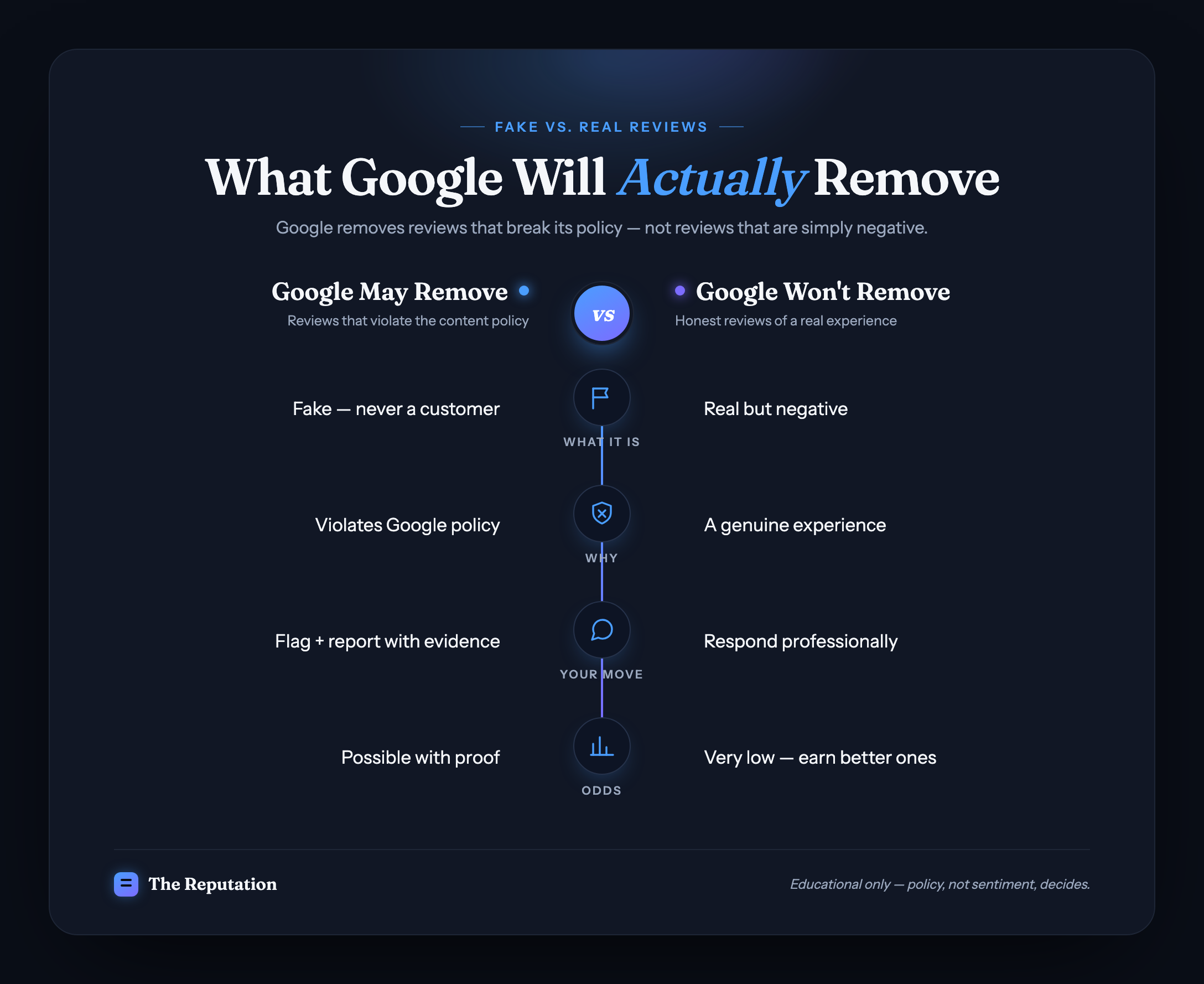
Google removes reviews that violate its content policy, such as fake reviews, spam, off-topic posts, and conflicts of interest, not reviews that are simply negative. If a real customer left an honest 1-star review, no flag or report will make it disappear, but a fake review from someone who was never a customer is a different story. When you think a review crosses that line, Google review removal from The Reputation starts with an honest read of whether it actually breaks the rules.

Can you get a bad Google review removed?
Sometimes, but only when the review breaks a rule, not just because it stings. This is the single most common misunderstanding business owners have about their reviews. A one-star rating with a paragraph of pointed criticism is protected as a genuine opinion, even if you believe it is unfair. Google's system is built to preserve honest feedback, including the negative kind, because that feedback is what makes the reviews useful to the people reading them.
What Google does act on is content that violates its published policies. The Google review removal service exists for exactly this gap: the fake, planted, or policy-breaking reviews that should never have been posted, as opposed to the honest ones you simply wish were kinder. Knowing which bucket a review falls into before you act saves you weeks of frustration chasing a removal that was never possible.
So the real question is not "how do I delete this review," but "does this review break one of Google's rules." The rest of this article walks through where that line sits.
What reviews will Google actually remove?
Google removes reviews that violate its prohibited and restricted content policies for Maps and Business Profiles. These are the categories that give you a legitimate basis to flag a review and a realistic chance of removal:
- Fake engagement. Reviews from people who were never customers, reviews posted by competitors, and coordinated review attacks meant to manipulate a rating rather than reflect a real experience.
- Spam. Duplicated content, reviews posted repeatedly, or content posted mainly to drive traffic or promote something unrelated to your business.
- Off-topic. Reviews about a social or political issue, a personal grievance, or an experience with a different business entirely, rather than the products or service you actually offer.
- Conflict of interest. Reviews left by you, your employees, or your competitors about your own or a rival business. Google treats these as inherently unreliable.
- Restricted or prohibited content. Harassment, hate speech, profanity, sexually explicit material, personal information, and other content that breaks its community standards.
The common thread is that the review misrepresents a real customer experience or breaks a conduct rule. A review that fits one of these categories has a genuine path to removal, especially when you can show evidence, such as records proving the person was never a client. Our review removal service handles these same policy categories across Yelp, Trustpilot, Glassdoor, and other platforms, each of which has its own version of the same rules.
What reviews will Google not remove?
Google will not remove a review just because it is negative, unflattering, or bad for business. If the review describes a real interaction with your company, even a deeply unhappy one, it stays up. That includes:
- A genuine customer who had a bad experience and said so
- A harsh but honest one-star rating with no explanation
- Criticism you believe is exaggerated or one-sided
- An old review about a problem you have since fixed
- A complaint that is embarrassing but factually true
This frustrates a lot of owners, and it should also reassure them. The same policy that protects a critic's honest review protects your honest positive reviews from being wiped out by a rival's flag. A platform that deleted reviews on request would be worthless to the customers who rely on it, so Google holds the line on genuine feedback.
Trying to force these reviews down through mass flagging or fake counter-reviews does not just fail, it can get your Business Profile penalized or suspended. That is why the honest answer to "can you remove this" is sometimes no, and why an ethics-first firm will tell you that up front rather than take your money for an impossible removal.
How do I flag and report a fake Google review?
If a review does break policy, you report it directly to Google and then, when the stakes justify it, escalate with evidence. Here is the basic path:
- Find the review. Open your Business Profile on Google Maps or in Google Search, or go to the reviews section of your dashboard.
- Flag it. Click the three-dot menu next to the specific review and choose the report or flag option.
- Pick the right violation. Select the category that actually fits, such as spam, fake, off-topic, or conflict of interest. Choosing the correct reason matters more than most people realize.
- Wait for the assessment. Google reviews the flag through automated systems and, sometimes, human moderators. There is no published timeline and no explanation when a decision comes back.
- Escalate if needed. If the first flag fails and you have a strong case, you can pursue it through Google Business Profile support with documented evidence.
The weak point in this process is evidence. Anyone can click "flag," which is why a bare flag on a genuine-looking review usually goes nowhere. A removal request lands much harder when it is backed by proof, such as records showing the reviewer was never a customer or documentation of a coordinated attack. That evidence-building and escalation is the part most owners do not have time to do well, and it is where our reputation management work and monitoring come in, catching and documenting policy-breaking reviews while the case is still fresh.
What should I do about honest negative reviews?
Respond to them, professionally and publicly, and then earn enough good reviews to outweigh them. Since Google will not remove an honest negative review, the goal shifts from deletion to damage control and long-term reputation building.
A good public response does two things. First, it shows the unhappy reviewer that you take the feedback seriously, which occasionally leads them to update or soften the review on their own. Second, and more importantly, it speaks to every future customer who reads that review. Most people expect a business to have a few negative reviews; what they are really judging is how you handle them. A calm, specific, non-defensive reply that acknowledges the issue and offers a next step can turn a bad review into a quiet trust signal.
From there, the durable fix is volume and recency. A steady flow of genuine, recent positive reviews pushes an old negative one down the page and pulls your average rating back up, without violating a single policy. That is the honest, policy-safe path to a stronger rating, and it is the foundation of any reputation management plan worth paying for.
The questions we hear most about what Google will and won't remove, answered plainly.
Not sure if a review breaks the rules? Get an honest read
If a Google review has you worried, the first step is knowing whether it actually violates policy or whether it is an honest review you will need to respond to instead. Start a case review with The Reputation and we will tell you honestly what can come down, what cannot, and what to do about the reviews that are here to stay. Performance-based pricing applies to qualified removals: scope, eligibility, and timing are confirmed during your case review, and some content is legally or technically constrained, so we tell you what is achievable before you commit.
This article was written by The Reputation Team, the online reputation specialists at The Reputation.org. We handle policy-based review removal, reputation management, and monitoring for businesses and individuals, and we only pursue removals that fit a platform's published rules.
Frequently asked questions
Will Google remove a review just because it's negative?
No. A low star rating and honest criticism do not violate Google's policies on their own. Google removes reviews that break its content rules, such as fake reviews from people who were never customers, spam, off-topic posts, or conflicts of interest. A genuine 1-star review of a real experience will almost always stay up, which is why responding well matters more than trying to delete it.
How do I report a fake Google review?
Open the review in Google Maps or your Business Profile, click the three-dot menu next to it, and choose the option to report or flag it. Pick the violation that fits, such as spam, fake, or conflict of interest. Reporting is a request for a human or automated review, not a guaranteed removal, so it helps to have evidence that the reviewer was never a customer.
How long does Google take to remove a flagged review?
There is no fixed timeline. Some flagged reviews are assessed within a few days, while others take weeks or are never removed. Google does not tell you the reasoning behind a decision, and a first request that fails can sometimes succeed on escalation with stronger evidence.
Can I get a review removed if the reviewer was never my customer?
That is one of the strongest cases you can make. Reviews from people who never used your business are a conflict-of-interest or fake-engagement violation under Google's policy. Removal is still not guaranteed, but documented proof that the person was never a customer gives Google a clear policy reason to act.
What should I do about an honest negative review I can't remove?
Respond to it professionally and publicly. A calm, specific reply that acknowledges the issue and offers to make it right often does more for future customers than a deletion would, because most people read the owner's response before they judge the review. Over time, steadily earning more genuine positive reviews outweighs the occasional honest 1-star.