You can't fully remove your name from Google search, but you can remove specific harmful results that break Google's policies or the law, and push the rest down with content you control. There is no button that erases you from the index, so the real work is sorting which results qualify for removal, which need a takedown at the source, and which you outrank over time. Google search removal from The Reputation starts with exactly that honest sort before any work begins.
If you want this in under a minute, watch a short video where Joshua Albanese, founder of The Reputation.org, explains how to remove your name from Google search.

We get this call constantly, and it almost always opens the same way: "I need my name off Google." We understand the feeling behind it. Something is ranking for your name that you'd rather nobody saw, and it feels like it's everywhere. But the honest version of the answer is more useful than the fantasy version, so here's what's actually possible and how each piece works.
Can you actually remove your name from Google search?
Not entirely, but you can remove individual results that qualify and suppress the ones that don't. Google indexes public web pages, so pages that mention you and follow Google's guidelines are eligible to appear, and no policy or payment changes that baseline. What changes is which specific results show up.
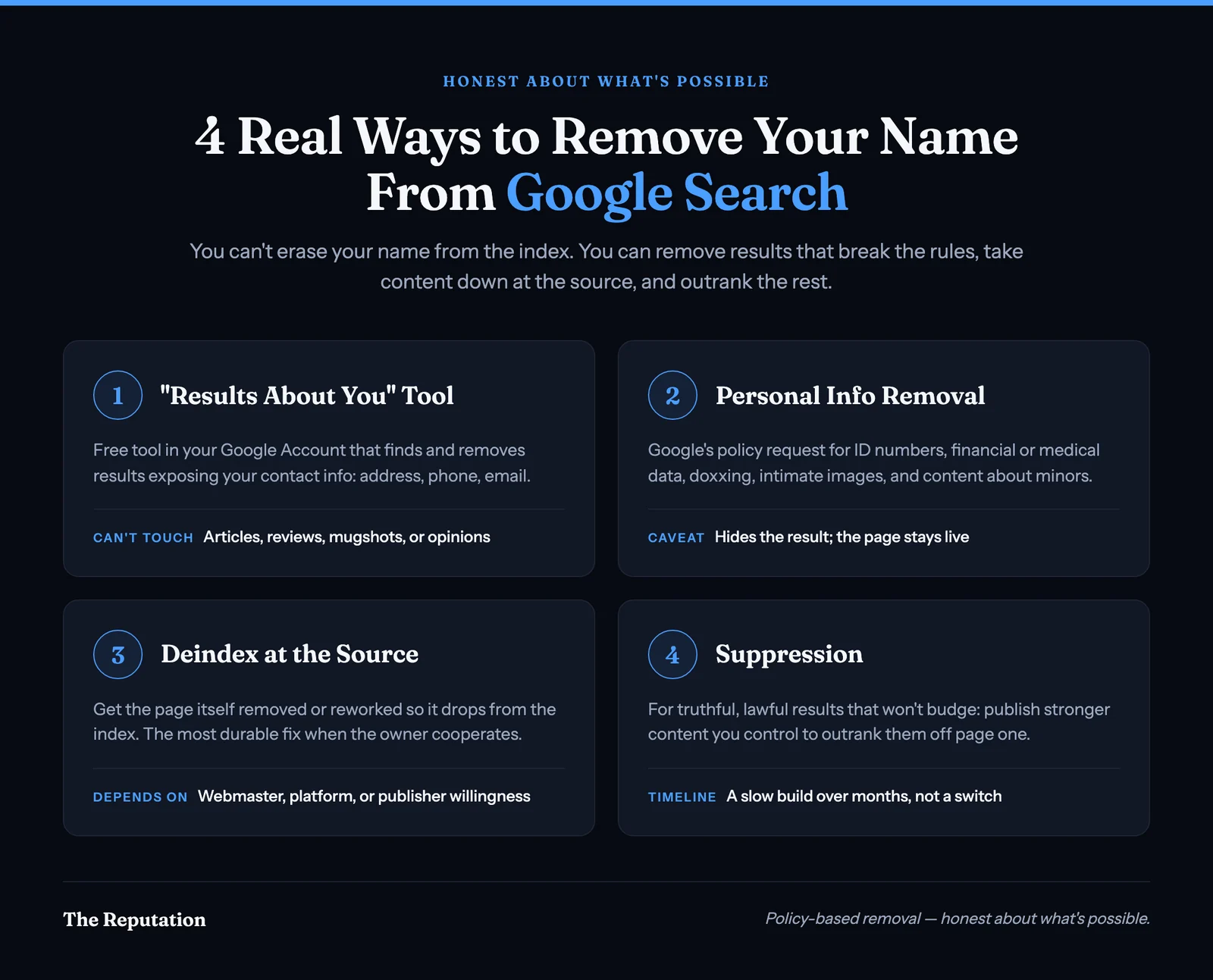
Think of it as three separate jobs, not one. First, remove results that break a rule, such as exposed personal information or unlawful content. Second, get content taken down at the source so it falls out of Google's index. Third, build and rank enough content you control that the results you can't remove drop off the first page where almost nobody looks.
The mistake we see most is treating all three as the same problem. A leaked home address and an unflattering old news article need completely different playbooks, and lumping them together wastes weeks. Sorting your results by which job they belong to is the step that makes everything after it work.
Start with Google's "Results about you" tool
Google's "Results about you" is a free tool in your Google Account that finds search results containing your personal contact information and lets you request their removal. If the thing haunting your name searches is your home address, phone number, or email address sitting on a data-broker page, this is the fastest legitimate first move, and it costs nothing.
Here's how to use it:
- Open your Google Account and search for "Results about you," or go to it directly from Google Search settings.
- Let it scan for results that contain your name alongside contact details like a phone number, home address, or email.
- Review the matches it surfaces and request removal on the ones that expose your personal contact information.
- Turn on alerts so Google notifies you when new results with your contact info appear later.
Be clear on its limits. This tool targets exposed contact information, not opinions, reviews, articles, or mugshots. It won't touch a critical blog post or an old news story, because those don't fall under the contact-information categories it covers. For anything beyond exposed personal details, you're into the removal-request and suppression routes below.
Removal requests for doxxing and personal information
When a result exposes sensitive personal information, Google's Personal Information Removal policy is the route, and it covers more than most people realize. This is Google's formal process for taking a qualifying result out of search, and it's separate from the general content-flag process used for spam or policy-violating pages.
Google's Personal Information Removal policy covers specific categories, including government ID numbers, bank and credit card details, medical records, login credentials, handwritten signatures, non-consensual intimate images, doxxing content that includes contact info with intent to harm, and content about minors. If your situation fits one of these, you submit a request and cite the matching category.
Two honest caveats. Removing the search result doesn't delete the underlying page; it just stops that URL from appearing when someone searches your name, so a source takedown is often the stronger long-term fix. And requests that don't clearly match a listed category are usually declined, which is why matching your facts to the right policy is the difference between a removal and a rejection. Our personal information removal work exists for exactly these cases, and for the messier ones that need escalation beyond a single form.
Deindexing at the source
The cleanest way to make a result disappear is to get the page itself removed or reworked, because a page that no longer exists eventually drops out of Google's index. When the source takes a page down, or removes your name from it, the search result fades once Google recrawls the URL. This is more durable than a policy removal, since it deletes the content rather than just hiding one search result.
The catch is that you're now dealing with a webmaster, a platform, or a publisher instead of Google, and their willingness varies widely. A small site owner may quietly remove a page after a polite, well-documented request. A news publisher rarely unpublishes a factual article, though some will update or de-index outdated content on request. Data-broker and people-search sites usually have an opt-out process, but you often have to repeat it as your information reappears.
If a page comes down but still shows in results, Google's Remove Outdated Content tool can speed up the removal of a URL that no longer returns the content. For mugshot and arrest pages specifically, the source-removal path plus policy grounds is often the strongest combination, which is why we handle those through dedicated mugshot removal work rather than a generic flag.
Suppression: what to do with results you can't remove
When a result is truthful, lawful, and the source won't budge, you don't remove it. You outrank it. Suppression means publishing and strengthening content you control, such as a personal site, professional profiles, and legitimate press, so it ranks above the result you want buried.
This is the honest answer for a real news article, a court record that's part of the public record, or a critical opinion piece that breaks no rules. None of those can be forced down through a removal request. What moves them is a steady body of accurate, well-optimized content about you that Google ranks higher, pushing the unwanted result to page two or beyond, where the vast majority of searchers never go.
Suppression is a slow build, not a switch. It can take months for new pages to earn authority and for the search results to reshuffle, and it needs maintenance so a suppressed result doesn't creep back up. That long game is the core of our search suppression and ongoing reputation management work, and pairing it with monitoring means a new problem result gets caught and addressed while it's still fresh and low-ranked.
Putting the realistic plan together
Sort your results first, then apply the matching route to each one. A single name search usually turns up a mix: some results you're proud of, one or two you'd rather hide, and occasionally something that clearly breaks a rule. Each needs its own answer, and trying one blanket approach on all of them is why so many DIY attempts stall.
Run down the list in order. Contact info exposed on a data broker goes to the "Results about you" tool. Sensitive personal data or doxxing goes to a Personal Information Removal request. A page you can get taken down goes to a source removal. Everything truthful and lawful that won't move goes into suppression. Individuals managing their whole footprint, rather than one bad link, often work this as a program, which is what our personal reputation management service is built around.
Set your expectation honestly at the start. You are not aiming to vanish from Google. You are aiming for a first page of results that is accurate, fair, and reflects the real you, with the harmful outliers either gone or buried where they no longer do damage.
The questions we hear most about removing a name from Google search, answered plainly.
Want to know what can actually come off your name search?
If searching your name turns up something you'd rather nobody saw, the first step is knowing which results can be removed, which need a source takedown, and which you'll need to suppress instead. Start a case review with The Reputation and we'll tell you honestly what's removable, what isn't, and what a realistic plan looks like for your name. Performance-based pricing applies to qualified removals: scope, eligibility, and timing are confirmed during your case review, and some content is legally or technically constrained, so we tell you what's achievable before you commit. This article is general information, not legal advice.
This article was written by The Reputation Team, the online reputation specialists at The Reputation.org. We handle policy-based content and record removal, search suppression, reputation management, and monitoring for businesses and individuals, and we only pursue removals that fit a platform's published rules or the law.
Frequently asked questions
Can you completely remove your name from Google search?
No, and any service that promises a full erase is not being honest with you. Google indexes the open web, so as long as pages that mention your name exist and follow their guidelines, those pages can appear. What you can actually do is remove specific results that violate Google's policies or the law, ask sources to take content down so it drops out of the index, and push the remaining results down the page with stronger content you control. The realistic goal is not a blank slate; it is a first page that reflects who you actually are.
What is Google's Results about you tool?
It's a free feature in your Google Account that scans search results for pages containing your personal contact information, like your home address, phone number, or email. When it finds a match, you can request removal of that result directly from the tool, and you can turn on alerts so Google notifies you when new results with your contact info appear. It does not remove articles, reviews, mugshots, or opinions about you; it targets exposed contact and personal identifiers. It is the first thing worth trying if the problem is your private details showing up in a search for your name.
How do I get personal information removed from Google?
Google has a Personal Information Removal policy that covers specific categories: government ID numbers, bank or credit card details, medical records, login credentials, signatures, non-consensual intimate images, doxxing content, and content about minors. You submit a request through Google's removal form and cite the category that fits. Google removes the search result when the content qualifies, though the underlying page stays live unless the source also takes it down. Requests without a clear policy match are usually declined, so matching your situation to the right category matters more than most people expect.
How long does it take to remove your name from Google results?
There's no fixed timeline. A clean Personal Information Removal request can be actioned in days, while source takedowns, legal escalation, and suppression play out over weeks or months. Google gives no published deadline and no explanation when a decision arrives. Suppression in particular is a slow build: it takes time for new content to earn rankings and push a harmful result off the first page, so treat it as an ongoing project rather than a one-time fix.
Is it worth paying a service to remove your name from Google?
It can be, when the content genuinely qualifies for removal and you don't have the time or evidence to file and escalate it correctly, or when the only realistic route is long-term suppression. An ethics-first firm should tell you honestly which of your results can come down, which can't, and what suppression would involve before you commit, and reputable firms use pay-on-success pricing on qualified removals. Be cautious with anyone who guarantees to wipe your name from Google entirely; that is not something anyone can deliver.