You can remove a Yelp review only when it breaks one of Yelp's Content Guidelines, such as having no real customer experience behind it, a conflict of interest, threats, or promotional spam; an honest negative review from a real customer almost never comes down. So the first real step is figuring out which kind of review you're actually dealing with, and Yelp review removal from The Reputation starts with exactly that honest read.
If you want this in under a minute, watch a short video where Joshua Albanese, founder of The Reputation.org, explains how to remove a Yelp review.
Can you actually remove a Yelp review?
Sometimes, but only when the review breaks Yelp's rules, not simply because it's negative or unfair. Yelp is unusually protective of what it treats as genuine consumer opinion, and it does not give businesses a delete button for reviews they dislike. What you can do is report a review for a specific guideline violation and ask Yelp's User Operations team to take it down.
That report is a request, not a command. A review that's fake, planted by someone who never visited, or written to threaten or advertise has a real path to removal. A review from a real customer who had a bad visit does not, even when the wording stings.
Before you spend hours fighting a review, be honest about which bucket yours falls in. That single judgment decides whether removal is even possible, and it's where most owners waste weeks re-reporting a review that was never going anywhere.
Why Yelp so rarely removes reviews
Yelp removes far less than most business owners expect, and it's worth understanding why before you try. Yelp's whole product is trust in consumer opinion, so its default is to leave reviews up unless they clearly break a rule. Per Yelp's Content Guidelines, the platform is built to protect first-hand experiences, including harsh ones.
Two things make Yelp different from most platforms. First, its automated recommendation software already hides a large share of reviews from your default page, so a review you hate may not even be affecting your visible rating. Second, Yelp openly resists business pressure and does not remove content just because the business disputes it.
So the realistic frame isn't "how do I delete this," it's "does this specific review break a specific guideline, and can I show that." When it does, you have a path. When it doesn't, the honest answer is that you build your rating a different way.
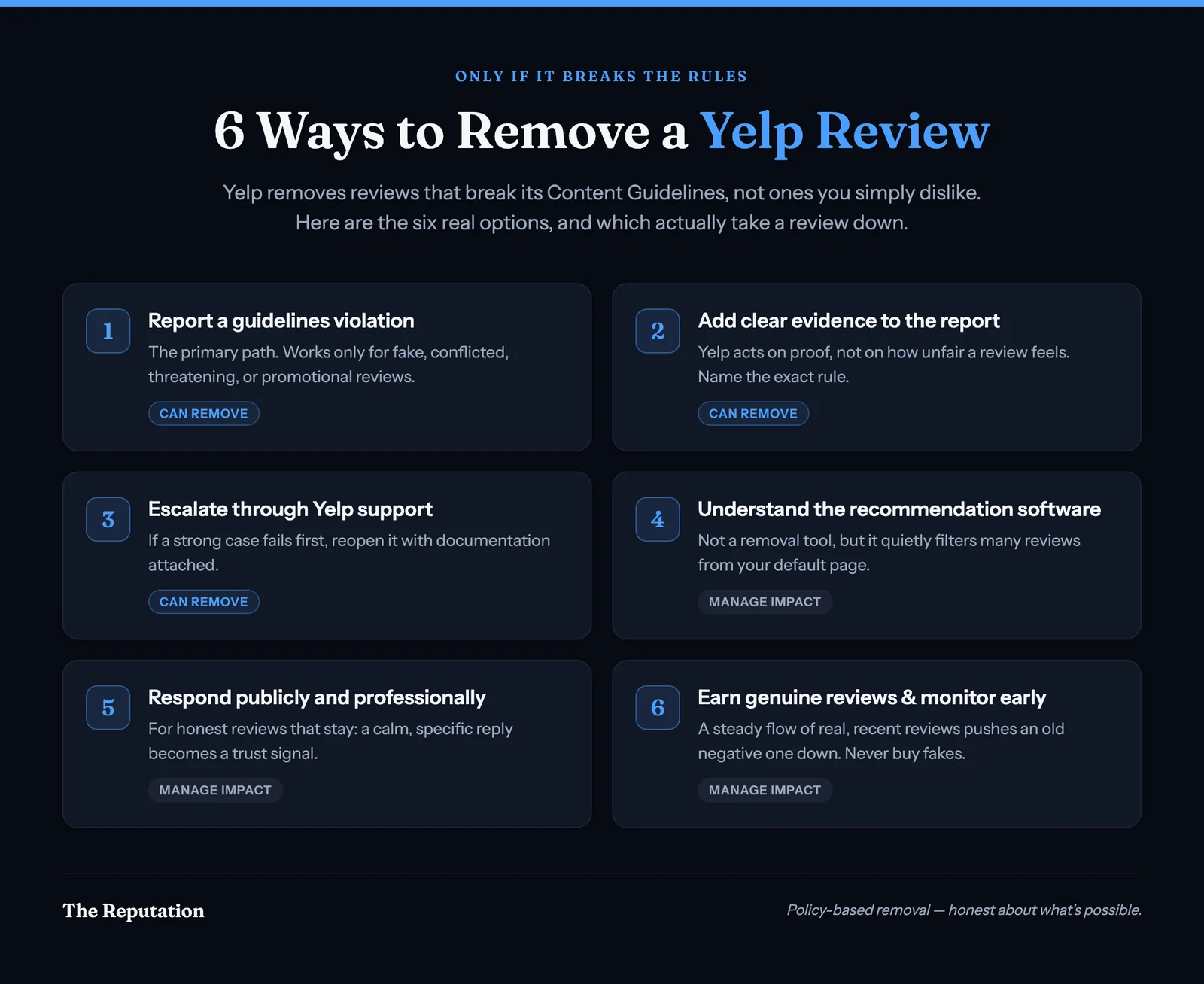
6 ways to remove or address a Yelp review
Here are the six real options, from the ones that can actually get a review taken down to the ones that manage its impact when removal isn't possible. Not all of them are removal, and we'll be clear about which is which.
1. Report the review for a Content Guidelines violation
This is the primary removal path, and it only works when the review breaks a published rule. Reportable categories include reviews with no genuine customer experience, conflicts of interest, threats or harassment, hate speech, lewd content, promotional material, and privacy violations like sharing someone's personal information.
To report it, hover over the review, open the three-dot "More Options" menu, and choose "Report Review," or use the Reviews tab in your Yelp business account. Pick the guideline the review actually breaks, not the one that feels closest.
2. Add clear evidence to your report
Anyone can click "report," which is exactly why a bare report on a review that looks legitimate usually goes nowhere. Yelp's team acts on evidence, not on how unfair a review feels to you.
If the reviewer was never a customer, note that plainly and be ready to show it. If the review names the wrong business, threatens you, or is a competitor with a stake in the outcome, say so and point to the specific guideline. A report that reads "this violates the no-firsthand-experience rule, and here is why" lands far harder than "this review is unfair."
3. Escalate through Yelp support when a report fails
A first report that goes nowhere isn't always the end. If you have a genuinely strong case, you can pursue it through your Yelp business account and Yelp's support channels, where a real person can look at the review again with your documentation attached.
Escalation works best when the guideline violation is obvious and provable, not when you simply disagree with the customer's opinion. Yelp does not reopen honest negative reviews, so save escalation for the reviews that clearly break a rule.
4. Understand the recommendation software (it isn't removal, but it matters)
Yelp's recommendation software automatically decides which reviews show by default and which get filtered into the "not currently recommended" section at the bottom of your page. It weighs signals like how active and established a reviewer's account is.
This isn't a removal tool, and you can't ask Yelp to recommend or filter a specific review. But it's why some reviews quietly stop affecting your visible rating on their own, and why chasing a filtered review often isn't worth your energy.
5. Respond publicly and professionally
When a review is honest and can't be removed, a calm public response becomes your best move. You can reply publicly from your business account, and every future customer reading that review later will see how you handled it.
A specific, non-defensive reply that owns the issue and offers a next step can quietly turn a bad review into a trust signal. Most people expect a business to have a few negative reviews; what they're really judging is your response.
6. Earn genuine reviews and use monitoring to catch problems early
The durable fix is volume and recency. A steady flow of recent, real reviews from active Yelpers pushes an old negative one down and pulls your rating back up, without breaking a single guideline. Never buy or solicit fake reviews; Yelp penalizes that hard, including public consumer alerts on your page.
Catching a problem review while it's fresh, with the paper trail still intact, is far easier than challenging one you notice six months later. That early-catch work is where our reputation management and monitoring come in.
What Yelp reviews can't be removed?
Yelp will not remove a review just because it's negative, embarrassing, or bad for business. If the review describes a real interaction with your company, it stays up, and no amount of reporting changes that. That includes:
- A real customer who had a genuinely bad visit and wrote about it
- A blunt 1-star with little or no explanation
- Criticism you feel is one-sided, exaggerated, or missing context
- An old review about a problem you've since fixed
- A complaint that's embarrassing but factually true
This is frustrating, and it should also be reassuring. The same rule that keeps a critic's honest review online is what protects your honest positive reviews from a rival trying to mass-report them off your page.
Trying to force honest reviews down anyway, through false reports or a wave of fake counter-reviews, doesn't just fail. It can trigger a Yelp consumer alert on your page, which is a far worse look than the single review you were trying to remove. Yelp isn't alone in this, either; our broader review removal work applies the same policy logic across Google, Trustpilot, Glassdoor, and other platforms, each with its own version of these rules.
When is it worth bringing in help?
When a review genuinely breaks a guideline and you don't have the time to build the evidence and escalate correctly. The value isn't a secret backdoor to Yelp; it's the diagnosis, the documentation, and the correct guideline framing that a bare report almost never carries.
An ethics-first firm should tell you honestly whether your review is removable before you commit. If it's an honest negative review, the right advice is to respond and rebuild, not to sell you a removal that can't happen. Nobody can guarantee removal of a genuine review, and any service that promises to, or claims it can pay Yelp, is worth avoiding.
If you want a second opinion on a specific Yelp review, our Yelp review removal case review reads it against the actual guidelines and tells you plainly what's achievable.
The questions we hear most about removing Yelp reviews, answered plainly.
Want to know if your Yelp review can actually come down?
If a Yelp review is hurting your business, the first step is knowing whether it breaks the Content Guidelines and can be removed, or whether it's an honest review you'll need to respond to instead. Start a case review with The Reputation and we'll tell you honestly what can come down, what cannot, and what to do about the reviews that are here to stay. Performance-based pricing applies to qualified removals: scope, eligibility, and timing are confirmed during your case review, and some content is legally or technically constrained, so we tell you what's achievable before you commit. This article is general information, not legal advice.
This article was written by The Reputation Team, the online reputation specialists at The Reputation.org. We handle policy-based review removal, reputation management, and monitoring for businesses and individuals, and we only pursue removals that fit a platform's published rules or the law.
Frequently asked questions
Can Yelp remove a review just because it's negative?
No. Yelp removes reviews that break its Content Guidelines, such as reviews with no real customer experience, conflicts of interest, threats, hate speech, or promotional spam. An honest 1-star from a real customer describing a real visit almost always stays up, no matter how unfair it feels. The realistic play there is a calm public response and a steady flow of genuine reviews over time.
Why does Yelp not recommend some of my good reviews?
Yelp runs automated recommendation software that decides which reviews show by default and which get filtered into a 'not currently recommended' section. It weighs factors like reviewer activity, history, and how established the account is. The software is not a report button, so you can't ask Yelp to recommend a specific review; you build a base of reviews from active, established Yelpers over time.
How do I report a Yelp review?
Hover over the review, click the three-dot 'More Options' menu, and choose 'Report Review,' or report it from the Reviews tab of your Yelp business account. Pick the guideline the review actually breaks. Yelp's User Operations team assesses the report; it is a request, not a guaranteed removal, and Yelp does not remove content just because a business disputes it.
How long does Yelp take to remove a reported review?
There is no published timeline. Some reports are assessed within a few days, others take weeks, and many reported reviews are never removed. Yelp rarely explains its decisions, and a report that fails once can sometimes succeed with clearer evidence that the review breaks a specific guideline.
Can I pay Yelp to remove a bad review?
No. Yelp does not offer pay-to-remove, and advertising with Yelp does not buy review removal or change the recommendation software. Any service claiming it can pay Yelp to delete a review is misrepresenting how the platform works. A legitimate firm tells you honestly whether a review breaks the guidelines before you commit, and reputable firms use pay-on-success pricing for qualified removals.