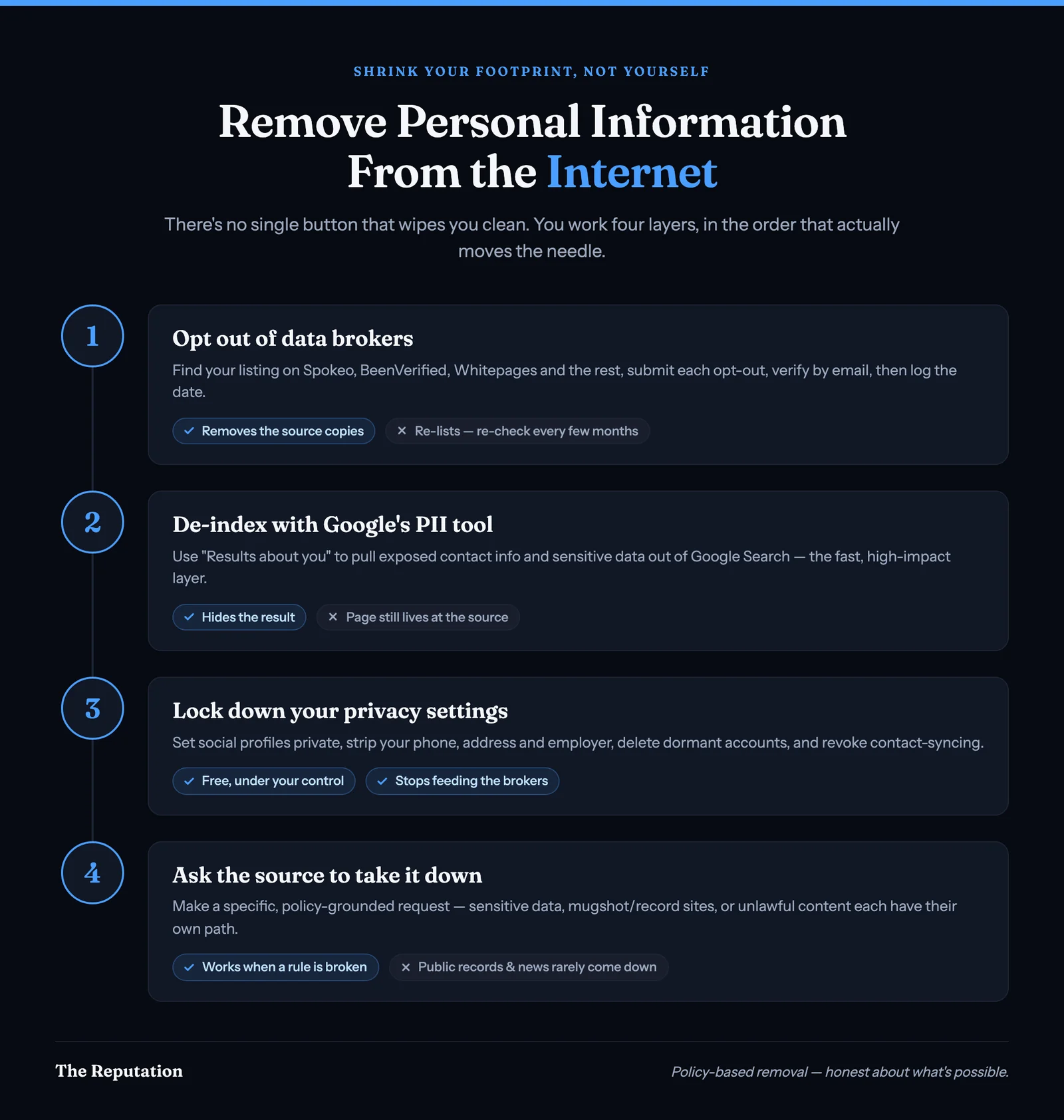
Removing personal information from the internet is a layered job: opt out of the data broker and people-search sites, use Google's PII removal tool to de-index sensitive results, lock down your own privacy settings, and ask the original sources to take content down. There's no single button that wipes you clean, so the realistic goal is a small, managed footprint. Our personal information removal service works these layers in exactly that order.
If you want this in under a minute, watch a short video where Joshua Albanese, founder of The Reputation.org, explains how to remove personal information from Google.

How do I remove my personal information from the internet?
You remove it in layers: data broker opt-outs first, then Google search de-indexing, then your own privacy settings, then source takedowns. No layer alone gets you all the way, which is why people who try just one give up frustrated. According to the U.S. Federal Trade Commission's guidance on data brokers, these companies build detailed profiles from public and commercial records and sell them widely. Start where the most copies of your data live, which is almost always the brokers.
The honest framing matters here. You cannot delete public records, old news coverage, or court filings just because you dislike them. What you can do is remove your information from the sites that repackage and sell it, push the rest out of easy reach, and keep it from creeping back.
Think of it as shrinking your footprint, not erasing it. That reframe is the difference between a plan that works and a month of chasing pages that were never going to disappear. The rest of this guide walks each layer in the order that actually moves the needle.
What are data brokers and how do I opt out?
Data brokers are companies that scrape public records and commercial data to build sellable profiles of you, then publish them on people-search sites. Names most people recognize include Spokeo, BeenVerified, and Whitepages, and the FTC has documented how the broader ecosystem operates at scale. Search your own name plus your city to see which sites already list you.
Opting out follows a similar pattern on most sites, though each one buries the process a little differently:
- Find your listing. Search the site for your name and location, and open the specific profile that's actually you.
- Locate the opt-out page. Look for a link labeled "opt out," "remove my info," "do not sell my personal information," or "privacy," usually in the footer.
- Submit the removal request. Paste the URL of your profile if asked, then follow the steps to confirm it's yours.
- Verify by email. Most brokers send a confirmation link you must click, and some add a phone or text step.
- Log the date and re-check. Record which sites you cleared and when, because listings return and you'll want to catch them.
The two things that trip people up are scale and recurrence. There are dozens of brokers, not three, and many smaller ones pull from the big aggregators, so clearing the majors often thins the rest. Even so, brokers re-scrape public records constantly, which means opt-outs are maintenance, not a one-and-done chore. That grind is a big part of why our personal information removal service exists, and it pairs with ongoing reputation monitoring so re-listings get caught while they're fresh.
How does Google's personal information removal work?
Google's "Results about you" tool removes the search result, not the page hosting it. You request that Google stop showing results that expose your personal contact information (home address, phone number, email) or certain sensitive data, and Google assesses each request against its removal policies. See Google's own removal request page for the current forms and eligible categories.
Understand what de-indexing does and doesn't do. The page still lives on the original website; it just becomes far harder to find because it no longer appears in Google for those queries. Use this tool for exposed contact details, doxxing content, and non-consensual sensitive material, and pair it with a source takedown wherever the page will let you.
De-indexing is the fast, high-impact layer because most people only ever look at page one of Google. If a damaging result about your name is ranking, our Google search result removal work focuses on exactly that: getting the specific result de-indexed or removed. This post is about pulling your data off the source sites; that page is about the results themselves.
How do I lock down my own privacy settings?
Tighten the accounts you control first, because they're the easiest source of exposure and the only layer you can fix in one sitting. A large share of the personal detail floating around comes from public social profiles, old accounts, and default sharing settings you never changed. This is free, it's under your control, and it stops feeding the brokers.
Work through the accounts that expose the most:
- Social media. Set profiles to private, remove your phone number, birthday, employer, and hometown from public view, and prune old posts that reveal your address or routine.
- Google account. Review your personal info visibility and location history, and turn off what you don't need public.
- Old accounts. Delete dormant accounts on forums, shopping sites, and apps you no longer use, since each one is a leak waiting to be scraped.
- People finder syncs. Revoke contact-syncing permissions that quietly upload your address book to third parties.
If a lot of exposed information traces back to your social accounts, our social media removal work can help with content you can't fully clear yourself. The point of this layer is prevention: the tighter your own settings, the less fresh material brokers and search engines have to index next time.
How do I get the original source to take content down?
You contact whoever controls the page and make a specific, policy-grounded request. This is the hardest layer, because unlike a broker opt-out, the site owner can simply say no. How far you get depends on what the content is and which rule or law it breaks, so match your request to the right basis.
A few realistic paths, from easiest to hardest:
- Sensitive personal data. Address, phone, or ID numbers posted without consent often violate a platform's own rules, so cite the specific policy when you report it.
- Records and mugshots. Some record and booking-photo sites have removal or "pay to remove" processes, though these need care; our background check removal and mugshot removal work handles these specialized sites.
- Unlawful content. Genuinely defamatory or illegal material may have a legal removal path, which is where documentation and the right framing matter most.
Public records and legitimate news coverage are the exception, not the target. Courts, government sites, and real journalism are legal to publish and almost never come down on request, so trying to force them wastes energy better spent on de-indexing and suppression. Being honest about that line is the whole point. We tell you what's realistically removable before you spend a dime chasing what isn't.
The questions we hear most about removing personal information from the internet, answered plainly.
Ready to see exactly what's exposed about you?
If your home address, phone number, records, or old accounts are showing up where they shouldn't, the first step is a clear map of what's actually out there and what can realistically come down. Start a case review with The Reputation and we'll show you what's exposed across the data broker ecosystem, what we can remove, and what needs ongoing monitoring instead. Performance-based pricing applies to qualified removals: scope, eligibility, and timing are confirmed during your case review, and some content is legally or technically constrained, so we tell you what's achievable before you commit. This article is general information, not legal advice.
This article was written by The Reputation Team, the online reputation specialists at The Reputation.org. We handle data broker opt-outs, personal information and record removal, reputation management, and monitoring for businesses and individuals, and we only pursue removals that fit a platform's published rules or the law.
Frequently asked questions
Can you fully remove all personal information from the internet?
No, and any service that promises a clean wipe is not being honest with you. Public records, news articles, and court filings are legal to publish and rarely come down. What you can realistically remove is your information from data broker and people-search sites, and you can suppress or de-index a lot of the rest. The honest goal is to shrink your exposure to a small, managed footprint, not to erase yourself.
How do I remove my information from data broker sites?
Find your profile on each site, then use its opt-out or 'do not sell my info' page, which usually asks you to confirm the listing and verify by email. Start with the big aggregators like Spokeo, BeenVerified, and Whitepages, since smaller sites often pull from them. The catch is scale and recurrence: there are dozens of brokers, and they re-scrape public records, so listings come back and need re-checking every few months.
Does Google's 'Results about you' tool actually remove information?
It removes the result from Google Search, not from the website hosting it. Google's PII removal tool lets you request that pages exposing your phone number, home address, email, or certain sensitive data be taken out of search results. The underlying page still exists, so the durable fix is to also opt out at the source. De-indexing just makes it far harder to find.
How long does it take to remove personal information from the internet?
Individual opt-outs are often processed within a few days to a few weeks, and Google PII requests can take days to weeks to be assessed. Covering the full broker ecosystem takes longer because there are so many sites. Because brokers re-list, this is maintenance, not a one-time task, which is why ongoing monitoring is part of any serious plan.
Is it worth paying a service to remove personal information?
It can be, when your exposure is wide, includes sensitive records, or you don't have time to work dozens of opt-out forms and re-check them for re-listing. A reputable firm should show you what's actually exposed and what is realistically removable before you commit. Be wary of any promise of total, permanent erasure, because that is not how public data works.