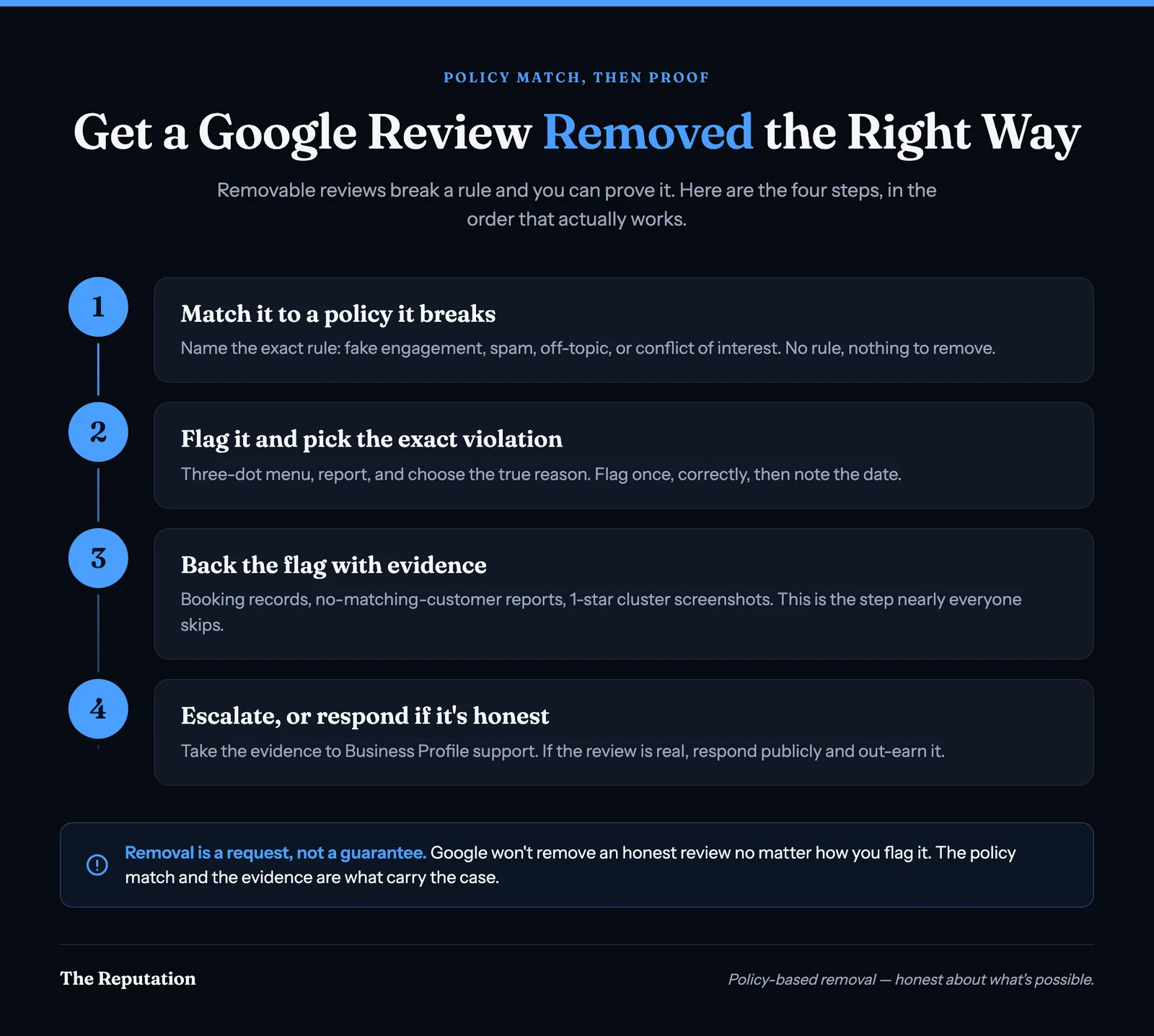
You get a Google review removed by matching it to a specific policy it violates, reporting it, backing that report with evidence, and escalating when the first flag fails. That's four steps, and the order matters more than the clicking. A separate question is whether your review can come down at all, which we cover in can you remove a Google review; this guide assumes you've decided it breaks a rule and now want the exact process. Google review removal from The Reputation runs these same four steps for you when the stakes are high.
We spend a lot of our days doing exactly this, and the pattern almost never changes. The owners who get a review removed didn't flag harder or complain louder. They matched the review to a rule, proved it, and escalated once with the proof in hand. The owners who fail usually skipped straight to clicking "flag" and hoped. So here are the four steps, in the order that actually works.
Step 1: match the review to a Google policy it breaks
Before you touch the flag button, name the exact policy the review violates. Google only removes reviews that break its prohibited and restricted content policies, not reviews that are simply negative or unfair. If you can't name the rule, there's nothing to remove.
Most removable reviews fall into one of these buckets:
- Fake engagement. A review from someone who was never a customer, a competitor posing as a client, or a coordinated 1-star attack meant to tank your rating rather than describe a real visit.
- Spam. The same review posted repeatedly, or a post written mainly to advertise or drive traffic somewhere unrelated to your business.
- Off-topic. A rant about politics, a personal dispute with nothing to do with your service, or feedback clearly meant for a different business.
- Conflict of interest. A review from you, your own staff, or a former employee with a grudge. Google treats anyone with a personal stake as unreliable.
- Restricted content. Harassment, hate speech, profanity, or personal details like a home address or phone number.
If your review fits one of these, you have a real basis to proceed. If it's an honest account of a genuinely bad experience, it does not qualify, and Step 4 of this guide points you to what to do instead. Getting this read right saves you weeks of flagging something that was never going to move.
Step 2: flag the review and pick the exact violation
Report the review to Google directly, and choose the violation category that genuinely matches. This is the mechanical part, and it takes about two minutes.
- Find the review. Open your Business Profile in Google Maps or Google Search, or go to the reviews section of your Business Profile dashboard, and locate the specific one.
- Open the menu. Click the three-dot icon next to that review and choose the report or flag option.
- Pick the accurate reason. Select the category from Step 1 that actually fits, spam, fake engagement, off-topic, or conflict of interest. Choosing the correct reason matters far more than most people expect, because it routes the review to the right check.
- Submit and note the date. Google won't confirm or explain the outcome, so record when you flagged it and check the listing yourself over the following weeks.
One flag per review is enough. Flagging the same review over and over from multiple accounts doesn't speed anything up, and Google can read a burst of coordinated flags as manipulation, which hurts your case rather than helping it. Flag once, correctly, then move to the part that actually decides most outcomes.
Step 3: back the flag with evidence
Attach proof that the review breaks the policy you named, because a bare flag on a review that reads like a normal complaint almost always fails. This is the step nearly everyone skips, and it's the one that separates a removal from a dead end.
Google's reviewers can't tell a fake review from a real one just by reading it. A well-written fake looks exactly like a real complaint on the screen. Your job is to hand them the context they can't see. Depending on the violation, useful evidence includes:
- Booking, invoice, or CRM records showing the reviewer's name never appears as a customer
- Screenshots of a sudden cluster of 1-stars posted in the same short window
- A reviewer profile that has left the same complaint across several unrelated businesses
- Messages or posts where a competitor or former employee admits to the review
Timing works for or against you here. A review you catch and document in the first days is far easier to challenge than one you notice six months later, after the account has gone quiet and the paper trail has gone cold. Catching and documenting these fast is exactly what our reputation monitoring work is built to do, so the evidence exists while the case is still winnable.
Step 4: escalate with the evidence, or respond if it can't come down
If the first flag goes nowhere and you have a documented policy violation, escalate through Google Business Profile support. If the review is honest and can't come down, switch tactics entirely.
For a qualified review, escalation is where the evidence pays off. Contact Google Business Profile support and, in some cases, you can get a support agent to review the case with your documentation attached. The framing that lands is specific: not "this review is unfair," but "this review violates the fake-engagement policy, and here are the records proving the reviewer was never a customer." That's the language Google's process is built to act on, and a first flag that failed can succeed on escalation with it.
But be honest with yourself about which review you have. If it's a real customer describing a real experience, no amount of escalation removes it, and trying to force it down with false flags or fake counter-reviews can get your whole profile penalized. In that case, respond publicly and calmly, own what you can, and offer a next step. Then earn a steady stream of genuine positive reviews to outweigh the one you can't delete. That volume-and-recency approach is the policy-safe path to a stronger rating, and it anchors any reputation management plan we build. The same four-step logic, adapted to each platform's rules, is also how our broader review removal work handles Yelp, Trustpilot, and Glassdoor.
How to dispute a Google review (the one appeal)
If you flagged a review and Google said no, you dispute it by filing an appeal. You can file it yourself, or through a removal team that builds the case for you.
Google's Business Profile help gives you one appeal, inside the Reviews Management Tool. Open that tool and choose "Appeal eligible reviews." Because you only get one, three things decide whether it works.
The exact rule. Name the policy the review breaks, such as fake engagement, off-topic, or conflict of interest. "Unfair" isn't a rule.
Proof Google can't see by reading it. Booking records with no matching name are one example. Screenshots of a sudden cluster of 1-stars are another.
One shot, no explanation. You get a single appeal, and Google won't explain its answer. So file it once, with Steps 1 and 3 already done.
That's a second job on top of running your business. It's also the work Google review removal from The Reputation does every day. We know which policy fits, we build the evidence, and we work the appeal.
The questions we hear most about getting a Google review removed, answered plainly.
Get an honest read before you spend hours on this
The fastest way to waste a week is to flag a review that was never removable. Before you start, it's worth knowing whether yours breaks a policy and qualifies, or whether it's an honest review you'll need to respond to instead. Start a case review with The Reputation and we'll tell you honestly which one you have, and run the four steps for you when it's the kind that can come down. Performance-based pricing applies to qualified removals: scope, eligibility, and timing are confirmed during your case review, and some content is legally or technically constrained, so we tell you what's achievable before you commit. This article is general information, not legal advice.
This article was written by The Reputation Team, the online reputation specialists at The Reputation.org. We handle policy-based review removal, reputation management, and monitoring for businesses and individuals, and we only pursue removals that fit a platform's published rules or the law.
Frequently asked questions
How do I get a Google review removed step by step?
Four steps. First, match the review to a specific Google content policy it breaks, such as fake engagement, spam, off-topic, or conflict of interest. Second, flag it through the three-dot menu on the review and pick that exact violation. Third, gather evidence that backs the policy claim, like records showing the reviewer was never a customer. Fourth, escalate through Google Business Profile support with that evidence if the first flag fails. Removal is a request, not a guarantee, so the policy match and the evidence are what carry the case.
How long does it take to get a Google review removed?
There is no published timeline. Some flagged reviews are assessed within a few days, others take several weeks, and many are never removed at all. Google does not explain its decisions or notify you of the outcome, so you often have to check the listing yourself. A first flag that fails can still succeed later on escalation when you attach stronger evidence and name the correct policy category.
Do I need evidence to get a Google review removed?
For anything that isn't obviously spam, yes. A bare flag on a review that looks like a normal customer complaint almost always goes nowhere, because Google's reviewers can't tell it breaks policy just by reading it. Evidence such as booking records, a no-matching-customer report, or screenshots of a coordinated attack turns a vague this-feels-unfair claim into a documented policy violation, which is the form Google's process is built to act on.
What if I can't get the Google review removed?
If the review is honest and describes a real experience, Google will not remove it no matter how you flag it, so the play shifts. Respond to it publicly and professionally, then build a steady flow of genuine positive reviews that pushes the old one down and pulls your average back up. That is the policy-safe route to a stronger rating, and it's the backbone of any reputation management plan worth paying for.
Is it worth hiring a service to get a Google review removed?
It can be, when the review genuinely breaks policy and you don't have time to build the evidence and run the escalation yourself. An ethics-first firm should tell you honestly whether your review qualifies before you commit, and reputable firms use pay-on-success pricing for qualified removals, so you only pay when the content is actually gone. No one can guarantee removal of a genuine negative review, and any service that promises to is worth walking away from.