The cost of online reputation management in 2026 depends almost entirely on what you're trying to fix: monitoring and review response can run a few hundred dollars a month, while removing a ranking news article or a coordinated attack is priced case by case and costs far more. So the honest starting point isn't a price list, it's understanding the three ways this work gets billed, and how The Reputation prices a case follows directly from which of those three your situation calls for.

How much does online reputation management cost in 2026?
There's no single price, because the work isn't one thing. Reputation management covers everything from watching your name and responding to reviews, to suppressing a damaging search result, to removing defamatory content, and each of those is a different job with a different cost. What you pay tracks the difficulty of your specific situation, not a published rate card.
That's why almost every reputable firm refuses to quote a flat number before scoping your case. A single fake review, a ranking negative article, exposed personal information, and a coordinated attack across five platforms are wildly different problems. Pricing them the same would mean either overcharging the simple case or under-scoping the hard one.
So the useful question isn't "what's the price," it's "how is this priced, and what pushes my number up or down." The rest of this guide walks through the three pricing models you'll actually encounter, what drives cost within each, honest representative ranges, and the red flags that tell you a quote is either padded or too good to be true.
What are the three reputation management pricing models?
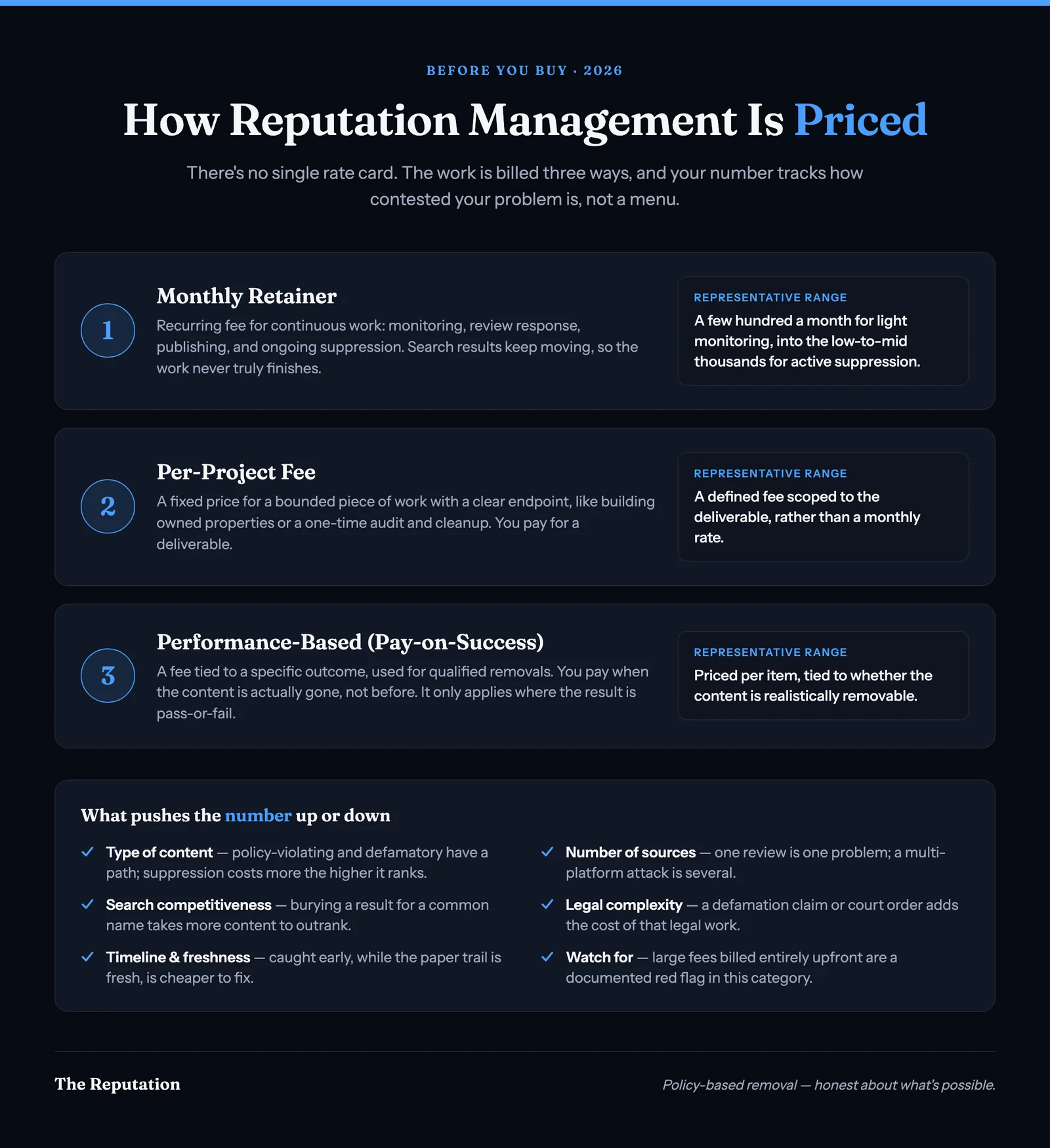
Reputation work is billed three ways in 2026: a monthly retainer for ongoing programs, a per-project fee for a defined piece of work, and performance-based pricing for qualified removals. Most real engagements use a combination, because most real situations have both a discrete problem and an ongoing exposure.
Here's how the three break down and where each one fits.
- Monthly retainer. A recurring fee for continuous work: monitoring, review response, content publishing, and ongoing suppression. You're paying for sustained effort over time, because search results and AI answers keep moving and the work never truly "finishes."
- Per-project fee. A fixed price for a defined, bounded piece of work with a clear endpoint, such as building and optimizing a set of owned properties, or a one-time audit and cleanup. You pay for a deliverable, not an open-ended engagement.
- Performance-based (pay-on-success). A fee tied to a specific outcome, used for qualified removals. You pay when the content is actually gone, not before. It only applies where the result is binary: the review, post, or record either comes down or it doesn't.
The retainer covers what's continuous. The project fee covers what's bounded. Performance-based covers what's pass-or-fail. Our reputation management programs run on retainer, our review removal work is where performance-based pricing usually applies, and a case review sorts out which parts of your situation belong in which bucket.
What drives the cost of reputation management?
The single biggest driver is how contested your problem is: how entrenched the negative content is, how many platforms it spans, and how hard the removal or suppression will be. A fresh fake review with a clear paper trail is a manageable job. A years-old news article ranking on page one of your name is a long, expensive fight.
Cost climbs with these factors:
- Type of content. Removing an honest-but-embarrassing result is often impossible; removing policy-violating content or defamation has a real path. Suppression, pushing a result down rather than deleting it, is sustained work that costs more the higher the negative currently ranks.
- Number of sources. One review on one platform is one problem. A coordinated attack across Google, Yelp, Trustpilot, and a complaint site is several problems that each need their own approach.
- Search competitiveness. Burying a negative result for a common name is harder, and more expensive, than for an unusual one, because there's more competing content to outrank.
- Legal complexity. Content that needs a legal escalation, a defamation claim, or a court order carries the cost of that legal work on top of the reputation strategy.
- Timeline and freshness. A problem caught early, while the paper trail is fresh, is cheaper to fix than one you address six months later after context has faded.
None of this is knowable from a form. It comes out of actually looking at your results, which is the entire reason honest firms scope before they quote. If you want to understand the mechanics behind why some content comes down and some doesn't, our guide on how to remove a Google review walks through the policy logic in detail.
What are realistic reputation management price ranges?
Here are representative ranges for 2026, offered as rough orientation, not a quote for your case. Every real number depends on the drivers above, and any firm that gives you a precise figure sight-unseen is guessing.
- Monitoring and review response: a representative range runs from roughly a few hundred dollars a month at the light end, scaling up with the volume of profiles and the response cadence you need.
- Active suppression and content programs: a representative monthly retainer here typically runs into the low-to-mid thousands, because pushing down a ranking negative takes sustained publishing and optimization.
- Project work: a bounded project, such as building out owned properties or a one-time cleanup, is usually a defined fee scoped to the deliverable rather than a monthly rate.
- Qualified removals: priced per item on a pay-on-success basis, so the cost is tied to the specific piece of content and whether it's realistically removable.
Treat those as illustrative bands, not promises. The honest version of "how much" always ends with "it depends on what we find," and a firm that won't say that is selling you certainty it can't actually deliver. Our pricing page explains the structure in full without pretending a fixed number exists before we've seen your case.
How does The Reputation price a case?
We price the way the work actually behaves: performance-based for qualified removals, retainer for ongoing influence, and a scoped fee where a project is genuinely bounded. On a qualified removal, you pay when the content is gone, not before, which is confirmed during your case review.
That structure exists for a reason. We carry the removal risk with you, so we won't take a case we don't believe is winnable, and we'll tell you that upfront rather than after you've paid. Ongoing work, shaping what people find when they look you up, is continuous by nature, so it runs on a retainer instead of a one-time success fee.
Most situations use both. We remove the specific thing that's hurting you now, then you can retain us for the monitoring and influence side so the next negative lands in a stronger context. Either way, the number and what's achievable come before you decide, not after.
The questions we hear most about what reputation management costs, answered plainly.
Want a real number for your situation?
If online content is costing you customers, opportunities, or sleep, the first step is knowing what fixing it actually involves and what it costs. Start a case review with The Reputation and we'll scope your situation, tell you honestly what's achievable, and give you a number you can stand on before you commit to anything. Performance-based pricing applies to qualified removals: you pay when the content is gone, and some content is legally or technically constrained, so we tell you what's realistic first. This article is general information, not legal or financial advice.
This article was written by The Reputation Team, the online reputation specialists at The Reputation.org, a national firm operated by Aurawave Inc. We handle policy-based review removal, content and record removal, reputation management, and monitoring, and we price every case honestly, tying removal fees to results and telling you what's achievable before you commit.
Frequently asked questions
How much does online reputation management cost per month?
Monthly retainers for ongoing reputation management vary widely by scope, provider, and how contested your search results are. Representative ranges run from a few hundred dollars a month for light monitoring and review response up to several thousand a month for active suppression and content programs against tough results. There is no honest fixed number before someone looks at what you're actually facing, which is why reputable firms scope first and quote second.
Why won't reputation companies just publish their prices?
Because the work isn't standardized the way an oil change is. A single fake review is a different job than a ranking news article or a coordinated attack across five platforms, and the cost tracks the difficulty, not a menu. Any firm that quotes a flat price before understanding your case is either padding for the worst case or setting you up for change orders later. Scope drives cost, so scope has to come first.
What is performance-based or pay-on-success pricing?
On a qualified removal, the fee is tied to the outcome: you pay when the content is actually gone, not before. It shifts the risk onto the firm, which is why an honest one won't take a case it doesn't believe is winnable. It applies to discrete removals, a fake review, a mugshot from a dismissed case, a defamatory post, rather than to ongoing influence work, which is continuous and runs on a retainer instead.
Are large upfront fees a red flag?
Often, yes. Large fees billed entirely in advance, before any work is done, are a documented pattern in this category. On qualified removals, a fair structure ties the fee to the result, so you pay when it's gone. Where a case genuinely needs scoped work upfront, such as a legal escalation or an ongoing program, an honest firm tells you exactly what that costs and why before you commit.
Is cheap reputation management worth it?
It depends entirely on what you need done. Light monitoring and review response can be legitimately inexpensive. But suppressing a ranking negative article or removing content across multiple platforms is real, sustained work, and a suspiciously low flat price for that usually means automated spam, fake reviews, or a promise nobody can keep. The cheapest option is expensive if it gets your profiles penalized or does nothing at all.