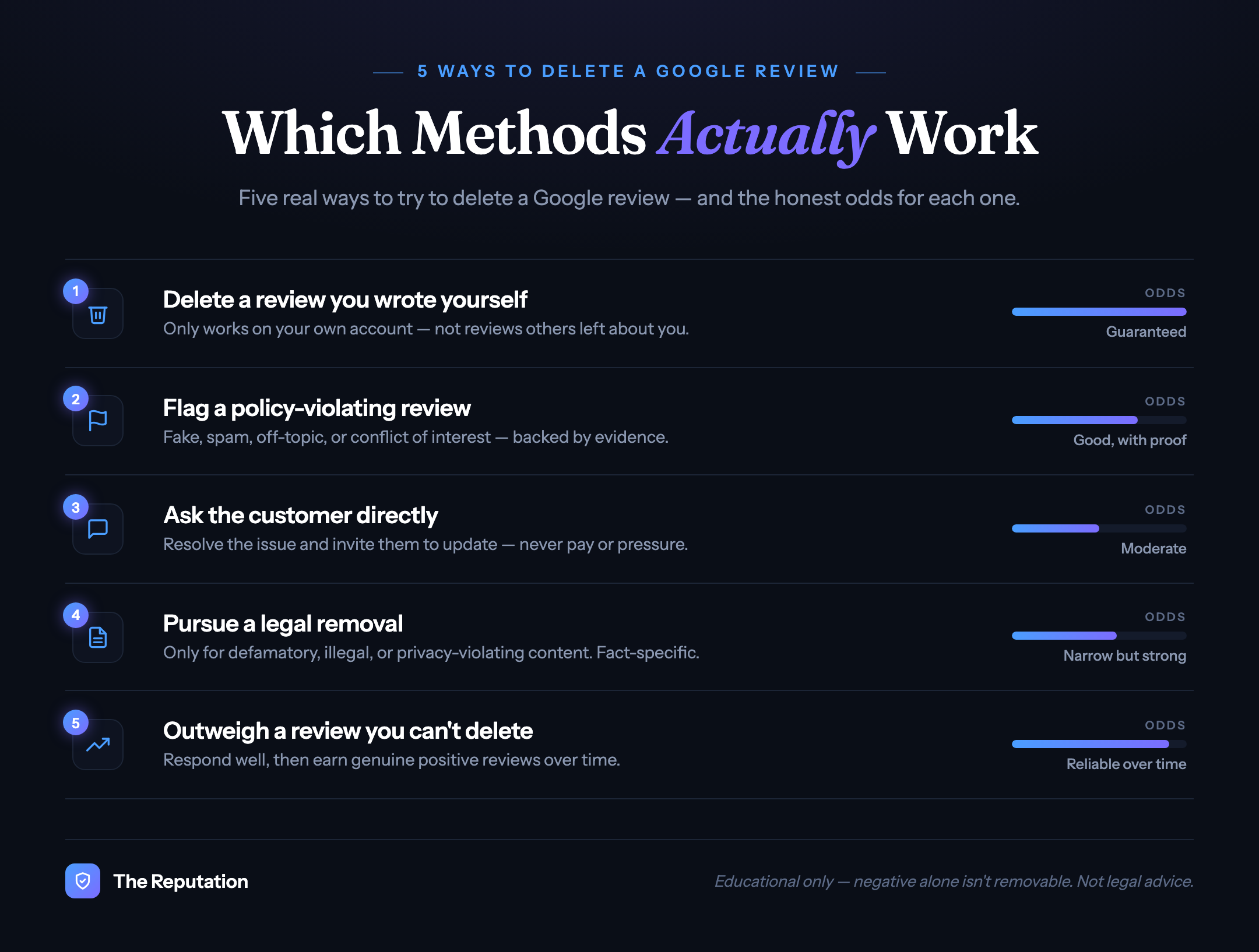
There are really only five ways to try to delete a Google review, and only some of them work: delete one you wrote yourself, flag a policy-violating review, ask the customer directly, pursue a legal removal, or outweigh a review you can't touch. Which one fits depends entirely on who wrote the review and whether it breaks Google's rules, and Google review removal from The Reputation starts by figuring out exactly that before you waste time on a method that was never going to work.

Below is an honest breakdown of all five methods, what each one can and cannot do, and the realistic odds for each. The uncomfortable truth up front: for a review someone else left about your business, there is no button you can press to make it vanish. Every real method is either a request to Google, a request to the reviewer, a legal process, or a long game of outweighing the review with better ones. Knowing which of those you're actually in saves you from chasing the wrong one.
Way 1: Delete a Google review you posted yourself
If you wrote the review, you can delete it outright, and this is the only method where deletion is fully in your control. Open Google Maps or your Google account's contributions, find the review under your own profile, click the three-dot menu, and choose edit or delete. It disappears immediately because it is your content.
This obviously does not help with a review someone else left about your business, but it matters more than it sounds. Business owners sometimes discover that a review causing them grief was posted by their own staff or from a business-linked account, which is a conflict of interest under Google's rules. If a review came from an account you or your team control, deleting it directly is cleaner and faster than flagging it, and it is worth auditing old reviews for exactly this before you assume every negative one came from an outsider. It is also a good reason to make sure nobody on your team is reviewing the business from a personal account, since Google can treat that as manipulation. For anything posted by an actual outside reviewer, though, you move on to the next four methods.
Odds: guaranteed, but only for your own reviews.
Way 2: Flag a review that breaks Google's policy
For a review someone else wrote, this is the primary method, and it works only when the review actually violates Google's content policy. You cannot delete a review because it is negative; you flag it because it is fake, spam, off-topic, or a conflict of interest. The categories Google will act on are:
- Fake engagement from people who were never customers, competitor-planted reviews, and coordinated 1-star attacks
- Spam such as duplicate posts or reviews written mainly to advertise or drive traffic elsewhere
- Off-topic content about a political issue, a personal dispute, or a completely different business
- Conflict of interest reviews from you, your staff, a competitor, or a former employee with a grudge
- Restricted content including harassment, hate speech, profanity, or someone's private personal information
To flag one, open the review in Google Maps or your Business Profile, click the three-dot menu next to it, choose report, and pick the violation that genuinely fits. Choosing the correct category matters more than most people realize. Google then assesses the flag through automated systems and sometimes human moderators, with no published timeline and no explanation when the decision lands.
What separates a flag that works from one that gets ignored is evidence and escalation. A bare flag on a review that looks legitimate usually goes nowhere, because anyone can click it. A request backed by records showing the reviewer was never a customer, screenshots of a coordinated attack, or a timeline that exposes a competitor gives Google a concrete policy reason to act, and it gives you something to escalate through Business Profile support if the first flag fails. The Google review removal service lives in exactly this method, and our wider review removal work applies the same policy logic to Yelp, Trustpilot, Glassdoor, and beyond.
Odds: good when the review truly breaks policy and you have evidence; near zero when it doesn't.
Way 3: Ask the customer to remove or update the review
Sometimes the fastest route to deleting a review is the reviewer themselves, and this is completely legitimate when they choose to do it. If you fix the underlying problem and reach out with a genuine, non-defensive apology or resolution, a meaningful share of customers will soften, update, or remove the review on their own. People are more reasonable than owners fear, especially when they feel heard.
There is a hard line here, though. You can ask, you can make things right, and you can invite them to reconsider. You cannot pressure them, offer to pay for a deletion, or make a refund conditional on the review coming down. Paying for review removal and gating refunds on reviews both violate Google's policies and can get your Business Profile penalized, which is a far worse outcome than the review you started with. Keep the ask honest and pressure-free, and treat any deletion as the customer's decision, not your entitlement.
Odds: moderate when you've genuinely resolved the issue; zero if you try to pressure or pay.
Way 4: Pursue a legal removal when a review is unlawful
In narrow situations, a review can be removed through a legal path rather than a policy flag. If a review is defamatory, contains illegal content, or exposes private personal information such as a home address, Google provides a legal removal process that goes beyond the standard flag, and in serious cases a court order can compel removal.
This is powerful but fact-specific, and it is easy to overreach. A review being false in your opinion is not the same as legally defamatory, which generally requires a provably untrue statement of fact rather than an unflattering opinion. "The staff were rude and the food was cold" is an opinion about an experience, even if you disagree; a fabricated claim that you did something you demonstrably never did is a different matter. The distinction is subtle, it varies by jurisdiction, and getting it wrong wastes time and money.
Because the bar is high and the documentation matters, this is the method where a professional read pays off most before you invest in it. Sending a heavy-handed legal threat over what is really a bad opinion can also backfire publicly, so this route rewards precision over aggression. Our reputation management work includes sorting which reviews have a real legal angle and which do not, so you do not spend months chasing a legal removal that was never viable. This is general information, not legal advice.
Odds: strong for genuinely unlawful content with proper documentation; weak for merely unfair reviews.
Way 5: Outweigh a review you can't delete
When a review is honest, negative, and unremovable, the fifth method is the only one left, and it is often the most valuable: bury it under genuine positive reviews and a strong public response. Since Google will not delete an honest review from a real customer, deletion stops being the goal and reputation-building takes over.
Start with a calm, specific public reply to the review itself. Most future customers read the owner's response before they judge the review, and a reply that owns the issue and offers a next step reassures them far more than a missing review would. A defensive or dismissive reply does the opposite, so treat the response as public-facing copy aimed at the next hundred readers, not a private argument with one unhappy reviewer.
Then build volume and recency. A steady flow of recent, genuine positive reviews pushes an old negative one down the page and lifts your average, all without breaking a single policy. The key word is genuine: buying reviews or funneling only happy customers to Google while steering unhappy ones elsewhere are both policy violations that can get your profile penalized. The durable, safe version is simply making it easy for every real customer to leave a review, then keeping it up consistently. Ongoing monitoring keeps you ahead of new reviews so nothing festers, and it is the backbone of any real reputation plan.
Odds: reliable over time; this is the method that always works when the others can't.
The questions we hear most about deleting a Google review, answered plainly.
Not sure which method fits your review?
If a Google review is hurting your business, the honest first step is figuring out which of these five methods actually applies, because that decides whether deletion is even possible. Start a case review with The Reputation and we will tell you honestly what can come down, what cannot, and what to do about the reviews that are here to stay. Performance-based pricing applies to qualified removals: scope, eligibility, and timing are confirmed during your case review, and some content is legally or technically constrained, so we tell you what is achievable before you commit. This article is general information, not legal advice.
This article was written by The Reputation Team, the online reputation specialists at The Reputation.org. We handle policy-based review removal, reputation management, and monitoring for businesses and individuals, and we only pursue removals that fit a platform's published rules or the law.
Frequently asked questions
Can you delete a Google review you wrote yourself?
Yes. If you wrote the review, open Google Maps or your Google account's contributions, find the review, use the three-dot menu, and choose edit or delete. This only works for reviews on your own account. You cannot delete a review that someone else posted about your business; you can only flag it for a policy violation and ask Google to remove it.
Can you delete a negative Google review about your business?
Only if it breaks Google's content policy. You cannot delete a review just because it is negative. Google removes reviews that are fake, spam, off-topic, or a conflict of interest, so a review from someone who was never a customer has a real chance of removal, while an honest 1-star from a real customer almost always stays. In that case the play is a good response plus more genuine reviews over time.
Does asking a customer to delete their review work?
Sometimes, and it is completely legitimate when the customer chooses to do it. If you resolve the underlying problem, a fair number of customers will update or remove a review on their own. What you cannot do is pressure them, offer to pay for a deletion, or gate a refund on it, because review gating and paid removals violate Google's policies and can get your Business Profile penalized.
Can Google delete a review through a legal request?
In narrow cases, yes. If a review is defamatory, contains illegal content, or reveals private personal information, there is a legal path to removal that goes beyond a normal policy flag. This is fact-specific and often requires proper documentation or a court order, which is why it is worth getting a professional read before you rely on it. This article is general information, not legal advice.
Is it worth paying a service to delete a Google review?
It can be, when the review genuinely breaks policy and you don't have the time or evidence to escalate it well yourself. A reputable, ethics-first firm will tell you honestly whether your review is deletable before you commit and uses pay-on-success pricing for qualified removals, so you only pay when the content is gone. Be wary of anyone who guarantees deletion of a real negative review; that is not something anyone can promise.